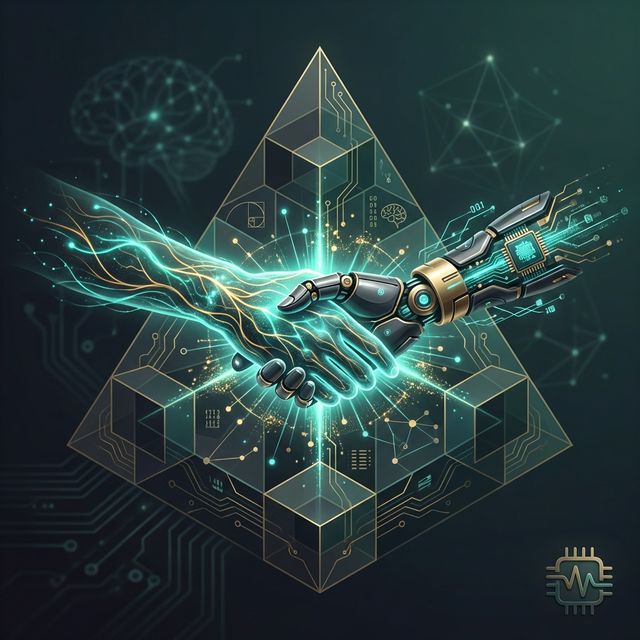
The Pingala Handshake: Why Protocols are the Future of AI Sovereignty
The Pingala Handshake Protocol (PINGHP) is a bidirectional communication constraint protocol designed to reduce entropy in human-AI-substrate interactions. In an era where "reasoning" models like OpenAI's o1 and autonomous swarms are becoming the industry standard, we find ourselves drowning in a sea of high-volume, low-yield tokens.
The industry is currently obsessed with Prompt Engineering—the art of asking better questions. But we believe the solution now isn't just better questions; it's a better Handshake.
Beyond the Prompt
Standard AI interactions are open-loop. You provide a prompt, and the model attempts to satisfy it with an unconstrained burst of tokens. This leads to Agentic Sprawl, where an AI begins navigating in a vacuum of its own logic, disconnected from the physical reality (the substrate) of the task at hand.
The Pingala Handshake Protocol (PINGHP) solves this by enforcing a 1:3:5:3:1 geometric constraint. And this isn't just an arbitrary number or template it's a "Braking System for Artificial Entropy."
The 1:3:5 Ascent (Source → Ground)
Every high-resonance session begins with the Ascent:
- [1] Apex Intent: A singular, atomic goal. No compound sentences. No ambiguity.
- [3] Operational Boundaries: Three discrete constraints that act as the "Bonds" of the session.
- [5] The Tierra Node: This is the protocol's secret weapon. It requires a grounding check in the Substrate State (the machine's physical reality) and Context Resonance (telemetry from the environment).
By forcing the AI to acknowledge the "geology" of the silicon it's running on before it speaks, we eliminate hallucinations. We anchor the silicon logic in the carbon requirement.
The 5:3:1 Descent (Ground → Return)
Only after the Resonance Pulse (a verifiable intersection between the AI and the substrate) is emitted does the information flow back to the human:
- [3] Synthesized Findings: The noise is compressed into signal.
- [3] Action Vectors: The signal is converted into buildable strategy.
- [1] Human Anchor: A single, final directive that closes the loop.
Why This Matters Now
Look at the current market. Models are getting smarter, but human focus is getting shallower.
- O1-style Reasoning: While powerful, it often operates in a "black box" of invisible tokens, increasing the "Sovereignty Gap" between what the machine does and what the human understands.
- Autonomous Agents: Swarms like AutoGPT or OpenClaw can quickly descend into "Decision Sludge" because they lack a rhythmic braking system. They run until they hit a wall or a budget.
PINGHP is the antidote. It prioritizes Symmetry over Volume.
It is named after Pingala, the ancient Indian poet who mapped the binary foundations of prosody. By mapping the "long and short syllables" of our digital work, we restore the rhythm of human focus.
A Stripe for Cognition
CSTACK is building the infrastructure layer for this new kind of human-AI coherence. Just as Stripe simplified the complex "handshake" of payments, we are simplifying the "handshake" of cognition.
The Pingala Handshake is the first step toward a future where AI is not a hallucinating navigator, but a GPS for Cognition—a tool that respects your biological limits and protects your digital sovereignty.