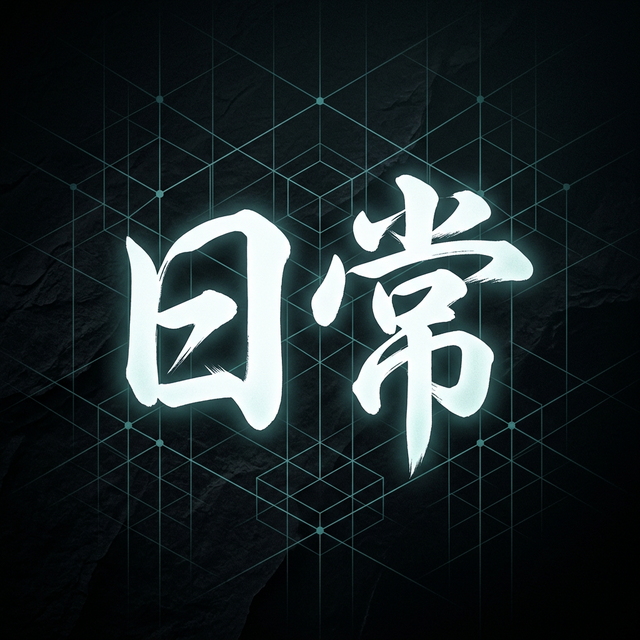
Thesis: Breakthroughs only matter for humans when they become 日常. In the Conscious Stack ecosystem, that means stabilizing stacks so coherence survives the ordinary day.
The word that quietly tells the whole story
日常 (Nichijou) is composed of two characters:
- 日 — the day. The loop. The repeating cycle.
- 常 — the constant. The customary. What holds.
Together: what is constant inside the day. This is not poetic garnish. It is a design instruction for your Cognitive Substrate.
Why infrastructure feels boring (and why that is the point)
“Infrastructure” is rarely exciting because it is designed to be repeatable, predictable, and available under fatigue. In other words, it is built for the "open ocean" of a standard Tuesday.
In our Introduction to Conscious Stack Design, we discuss how most people let tools dictate their direction. They confuse novelty for signal. But novelty is just the nervous system reacting to variance.
“常” is the opposite. It is the capacity to remain coherent when nothing special is happening. It is the "Star Path" you hold when the islands of inspiration are out of sight.
Breakthroughs that do not routinize become content, not capacity
In the AI age, insights are cheap. A model can generate a hundred “breakthrough thoughts” before breakfast. What remains scarce is embodied follow-through—a life that can hold a new pattern without collapsing back into default.
If a breakthrough does not become a daily move, it does not become infrastructure. At that point, your Maturity Level is effectively zero because your "Default State" hasn't actually shifted.
The uncomfortable mirror: “sticky products” vs sovereign routines
Silicon Valley understands 日常 better than we do. They build habit loops designed for Engagement—a metric for how much attention they can extract from you.
In CSD, we optimize for Coherence.
- Socially Engineered loops capture attention for someone else’s objective.
- Self-Actualized loops return attention to your own objective.
A sticky product wants to be your 日常 so it can extract your mind; a Conscious Stack is 日常 so it can protect it.
Turning 日常 into stack sovereignty
If I translate 日常 into CSD language, the mandate is simple: Design your stack so it returns you to the Anchor Slot under ordinary conditions.
An occupant only earns the right to be your Anchor if it passes the "Fatigue Test." It must be the place you go not just when you are inspired, but when you are dealing with:
- distractions and low energy
- emotional noise
- the entropy of Digital Noise
That is where a stack proves itself as true infrastructure rather than a highlight reel.
A simple “日常 protocol” for stabilizing stacks
This is a minimal routine you can run daily without heroics. It is an act of "Substrate Hardening."
- Open the day (2 minutes): Name the day, the constraint, and choose one coherence move.
- Return-to-Anchor capture: If something feels important, route it back to the Anchor immediately. Do not fragment your focus.
- Close the day (5 minutes): What got clearer? What needs a 5:3:1 gate to keep the noise out tomorrow?
常 is the missing feature
Most stacks are optimized for speed, but not for “常”—not for steadiness, reversibility, or integrity. If you want cognitive sovereignty, you have to design for the Default.
Because your life is not a demo. It is 日常.
A closing question
Where does your stack return you, automatically, when you are tired? That destination is your real infrastructure, and it defines your Cognitive Sovereignty.